
The Hanging Church
Today and yesterday we visited The Hanging Church and Saint George's Church in a section of Old Cairo known as Coptic Cairo. A highlight of the visit to this section was seeing the place where Yusuf, Maryam and Yesua (the Arabic names of Joseph, Mary and Jesus) lived during their exile in Egypt (Matthew 2:13-15).
In addition to experiencing the historical significance of these churches, we did worship in Coptic Cairo. We did so by praying together and by lighting candles in the traditional Eastern Orthodox fashion. Our visit to Coptic Cairo was an amazing experience across two days.
Is this our first post about Eastern Orthodoxy on this blog?
No, there are actually five others.
This blog contains a post from my visits to an earlier Coptic Christian church [link], two Greek Orthodox Churches [link and link], an Ethiopian Tewahedo Orthodox Church [link] and an Orthodox Church plant [link] attracting young evangelicals. All of these visits were in Charlotte.
Now to be in Africa in one of the heartlands of Eastern Orthodoxy was an exciting prospect.
I'll divide this blog post into multiple sections to delineate different themes...
Coptic Christianity
Who are the Coptic Christians?
Coptic Christians, also known as Copts, trace their roots back to the 1st century AD when Saint Mark arrived in Egypt and introduced the gospel to the local population. There is also a language and alphabet named Coptic. The Coptic language is now dead, except for its use in the liturgy of Coptic Christians. The same is true of the Coptic alphabet (below), which was closely related to Greek and is also used only for Coptic liturgy now.

Saint Mark

Coptic Alphabet
With the arrival of Islam into Egypt in the 8th century, Copts were forced to learn Arabic in both spoken and written form. If they refused, their tongues were cut out. With the forced proliferation of Arabic, Coptic was often printed next to Arabic in the liturgy. As a matter of fact, this practice continues until today. Virtually everyone reading the combined Coptic/Arabic scriptures today only understand the Arabic.
The picture below shows a copy of the Book of Psalms in both Coptic and Arabic. The column of Arabic on the right of each page. The Book of Psalms in the bottom of the picture is entirely in Arabic.

Coptic / Arabic Psalmody
How is the Coptic Church organized?
Coptic Christians are Orthodox Christians, which means that they are organized under the oversight of one man who is known as a Patriarch. The Coptic Patriarch at this time is a man named Pope Tawadros [link]. He lives in Alexandria, the famed ancient seat of high learning that is located in Lower Egypt, which is somewhat counterintuitively in the north of the country.

Coptic Pope Tawadros
How many Coptic Christians are there in Egypt?
No one really knows. The number is a political hot potato, as the dominant role of Islam in Egyptian life is a core theme in how Egypt sees itself. Because of this, the Egyptian government artificially keeps the number of Coptic Christians low. The percentage is sometimes offered to be as high as 20% but it is also mentioned to be as low as 6%. It is likely that the most accurate number is between 10% and 15%. Since Egypt has slightly more than 100 million people, the number of Coptic Christians may be around 15 million.
Consider that black Americans make up about 13% of the US population and you will get a sense of the proportion of Christians in Egypt's overall demographics.
What is the status of Copts in Egypt today?
Coptic Christians are an oppressed minority in Egypt. This is a fair description not only due to high levels of violence against individual Copts and Coptic communities, but also because there have a series of recent church bombings in Egypt. One of the most tragic incidents was the Palm Sunday bombings in 2017 [link]. This was a double suicide bombing that made the outside world aware of the way that Egypt's Muslims continually attack and abuse Egypt's Christians.

Palm Sunday Bombing, 2017
The state of affairs for Coptic Christians was especially bad under Anwar Sadat in the 1970s, but perhaps the worst period in recent history was when the Muslim Brotherhood took power in Egypt in 2012 after the Arab Spring. The Brotherhood (Ikhwan in Arabic) took steps to implement Islamic law in Egypt, including lowering the age of sexual consent to twelve years old. The Brotherhood was removed from power a year later in 2013, which brought a military government to power. The rise of this military government has benefitted the overall status of Coptic Christians in Egyptian society. The current state is as good as it has been in recent years, but their status as an oppressed group remains.
Despite the ongoing challenges for Coptic Christians in Egypt, they continue to worship Yesua two thousand years after the gospel came to their land.
When we entered Coptic Cairo, the entrance was filled with armed guards. Coptic Cairo is also closed to car traffic.

Egyptian Police
Before going to the next section, take a look at some of the ancient art of Copts. Coptic Cairo has a museum with the largest set of Coptic artifacts in the world. Here are some pictures from that Museum, it gives you a sense of the aesthetic of the Coptic Christian faith.
Click on the images and really look at them, they are striking.

Pantokrator, Yesua icon

Egyptian window

Maryam breastfeeding Yesua
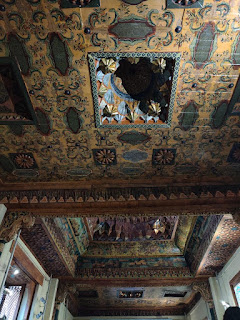
Ornate Coptic ceiling

Coptic Museum

Yesua and angels
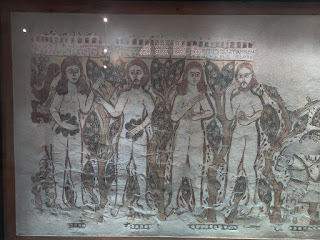
Adam and Eve, before and after The Fall

Coptic iconography

Sacred geometry

Coptic iconography

Icthuses

Coptic relics

Coptic stained glass

Coptic icon

Coptic marriage cart
Our Experience at The Hanging Church and St. George's Church
We felt a noticeable spiritual relief the moment we crossed the threshold into Coptic Cairo. Both Beth and I could actually feel* a difference in our bodies when we entered. We felt lighter and cleaner, in a spiritual sense. There was a feeling of heaviness that we left behind upon entering Coptic Cairo.
What was that? There is clear theology to say that God puts His mantle on people, but it may also be the case that He can put His mantle on places, too.
Once in Coptic Cairo, we were immediately peppered with offers for tour guides. There were men coming at us with statements about the criticality of having a guide to explain things to us. I never avail myself of tour guides but in this case, we decided to make an exception.
We hired George, a local Christian guy who gives tours of Coptic Cairo. He deserves special mention here because he was one of the highlights of our visit. Everything we saw in Coptic Cairo involved George's guidance, across both of the two days. He seemingly knew everybody in Coptic Cairo and he helped us immeasurably during our visit.

George, with us
George walked us through both The Hanging Church and Saint George's Church. What follows are some pictures of our visits to those churches.

Beth lighting candles

Pantokrator, a fixture in Orthodox churches

Greek Orthodox Church

One of the Coptic priests in Coptic Cairo

Column with Coptic Cross

Holy Family cave

Ancient well

Colored window

Pantokrator

Orthodox candles

Altar

Pulpit

Saint George's

Altar

Coptic tilework

Hanging Church

Roman fortress

Saint George's
The Hanging Church was built in the 7th century and Saint George's was built in the 10th century. Both had the complexity and ornateness that one expects from Orthodox churches with such age. Both had candles in sand, both had the faint smell of incense in the air and both had the clicking of shoes on marble floors. The two churches were unified in that they displayed a high level of ornateness that catches the eyes of people raised in more spartan Protestant settings.
Both churches were absolutely captivating.
The Hanging Church is built on top of a Roman fortress that was named The Babylon Gate. You can still see some of the structure of The Babylon Gate intact today (below).

Roman columns of The Babylon Gate
A key feature of Saint George's Church is the small cave that acts as a locational relic. It is the place where The Holy Family stayed during their exile in Egypt. This cave was marked with signs, maps and other things that called visitors' attention to it. There was even a water well used by The Holy Family.

Sign at Saint George's
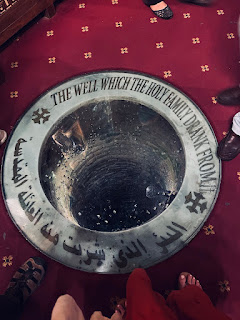
Well used by The Holy Family

Map of the exile

Yusuf, Maryam and Yesua on donkey back

The Cave
Visiting this place helped us feel closer to the people, places and locations of the Bible. It certainly helped us to feel a deeper connection to the stories that we study in our verdant city of Charlotte in the Southeast of North America. While Charlotte is deeply saturated with connections to The Holy Land due to the faith of most of its inhabitants, it is in fact very different from The Holy Land in so many ways.
This was a great visit to two beautiful churches.
Marked
As part of our trip, we learned that Coptic Christians have a tradition of getting cross tattoos on their right wrists. These tattoos are put on the faithful as a sign of fidelity against the aggression of the Islamic community around them. They also act as an entry pass into churches in Egypt.
Our tour guide George had such a tattoo on his right wrist.
These wrist tattoos have replaced a more ancient practice of branding crosses into flesh, which was the norm in centuries past. Now tattoos are mostly done on the wrist, although some of the faithful in rural North and East Africa get the tattoos on their foreheads.


When we learned about this practice, we had a quick discussion and determined that we were going to get Coptic wrist tattoos. With George's help, we acquired Jerusalem crosses on our wrists at a small shop front in Coptic Cairo.
Below are some pictures from the tattooing itself. You can clearly see that Beth deals with pain better than I do.


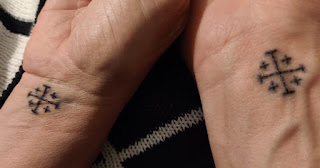
A Jerusalem cross has multiple layers of symbolism, including that the four smaller crosses symbolize the four gospels.
We love our new tattoos!
Visit to a Mosque
Later on Sunday, we visited the Mosque-Madrassa el Sultan. This is an Ottoman-era mosque and Islamic school that is open to tourists a few days a week. As we walked toward the mosque, we saw something of great symbolic significance that was also disturbing. We walked through an open stretch of land that contained cross-shaped rubble (we did not know what these were) while minarets of mosques cascaded off into the horizon.
It was chilling and seemed to depict visually the current dilemma of modern Egypt.
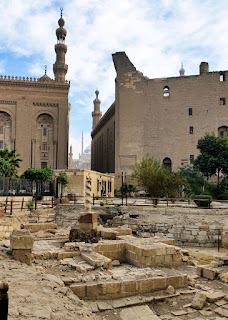
We visited the Mosque-Madrassa soon thereafter. Beth dressed in a modest way that is unfortunately required when visiting an Islamic location, which we will admit helped with the incessant tendency of men to leer at women in this part of the world.

As we entered the El Sultan Mosque, the fourth call to prayer (called maghrib) was blaring around us and across all of Cairo. A small number of the Islamic faithful walked around us into the mosque for salat (prayer). As is the case with all mosques, men and women filed into separate sections.
Beth and I parted ways to be with the men and women, respectively. We both prayed for them.
For me, God spoke into my time of prayer.
I received a word that Islam is the world's single largest religious edifice that is keeping people from the Truth. Islam is fueled by the spirit of religion and the spirit of flesh, which explains both the narrowness of spirit that Muslims show to those around them, as well as their tendency to "out demographic" other segments of society.
The dual realities of birth rates and polygamy mean that Islam will continue to grow rapidly.
Additionally, I was told that people need to be about the business of bearing witness to the Truth into the Islamic world.
These are the things I was given.

Muslim men praying at the mosque
Woman praying at the mosque
On Sunday, we also planned to go to Kasr el Dobara, an evangelical church in Cairo that attracts as many as 7,000 worshippers on any given Sunday. Unfortunately, we had to spend hours at the US Embassy due to my loss of my passport. We did not make the service. This was a big loss. We were excited to see the more modern incarnation of our faith at Kasr el Dobara.
It was not meant to be, it seems.
At the end of the trip, we sat and reflected on what we had experienced...
~ Exposure to an ancient form of Christianity.
~ Seeing the home of The Holy Family during their Egyptian exile.
~ Marveling at beautiful churches that date back over 1,000 years.
~ Getting Jerusalem cross tattoos to show our solidarity with Coptic Christians.
~ Having an opportunity to pray in a mosque for a group of people trapped in Islam.
Simply an incredible set of experiences!
The two of us cannot express enough gratitude for this time in Cairo, and especially Coptic Cairo. God is deeply present in Egypt. Our time there left us fascinated, engaged, inspired, filled with new understanding and new meaning, as well as perhaps feeling a bit of sadness .
We're grateful for this awesome trip!


