Sunday, January 31, 2021

41 :: Saint Ann Catholic Church

This morning I worshiped at St. Ann Catholic Church in South Charlotte. It ended up being a unique turn of events in a few ways. I enjoyed myself and found it to be my peak experience thus far in an aesthetic sense. Put simply, this was perhaps the most beautiful church I have visited on this spiritual pivot.

In the spirit of full candor, I think you have to be a Catholic and know "how to do it" before you can find a Catholic Mass really fulfilling. At the very least, that is appearing to be the case for me. 

I noted quickly that this seemed to be a bit of a different Catholic church. First, they offer a Latin Mass (this was not one), something that was largely discontinued around the world in the early 1960s. Secondly, they announced during the Mass that you could bring your candles by to be blessed during a special Mass to be held this week. Finally, they performed a unique ritual in front of me after the Mass was ended. More on that below.

In short, this was different than any Catholic church that I have visited during this spiritual pivot.

Since this is the case, I paused before I wrote the words "I worshiped at..." above. But I did bow my head and pray for everyone that was attending Mass, so we can count it was a worship experience.

How was this place a unique turn of events?

First, I have been driving past this church and school for twenty-seven years. I have also attended multiple festivals that the church hosted when they boys were little. Carnival type stuff. I always considered that its interior would likely be as non-descript as its exterior.

Boy, was I surprised.

Here's the exterior:


And - here is the interior (really click on these and zoom into them, there was stunning beauty in this place!):


I was slightly slack jawed for a moment when I walked in. What a beautiful church! The mural at the front is unlike anything I have experienced this far, perhaps only rivaled by St. Nektarios Church. It was simply stunning.

My favorite part of this stunning beauty? A small dose of Pentecostal imagery in this very Catholic church. There was a statue of an Apostle with a tongue of fire on his head, related to the events in Acts 2:1-4, in which the gift of tongues was first imparted to humanity.

Second unique turn of events is that this was the Mass where I got the idea clear in my head that Catholics primarily come to church to partake of the eucharist. Taking communion is the reason that Catholics go to church. Listening to the homily and seeing what the Priest has to say this week... it is definitely an important thing to them, but you quickly get the sense that a homily does not occupy the importance that a sermon might at a Protestant or evangelical church.

This is at least my impression at this time.

Here is a bit of the church during the homily, which also gives a great panorama of the church's interior:

Another nice thing that I saw was that this was a bit of a different church in terms of their overall traditional nature of the community. Many of the women were wearing a mantilla, the lace headcover that is often seen in Catholic churches. I watched one family in particular as they prayed with each other, participated in the responsive readings, as well as greeted each other during the section where you share the Peace of Christ with other attendees.

Here is that family:


Once the communion was over, the altar boys and two of the Priests departed.

I stayed around and intended to take some pictures. It was then that the third of final unique turn of events happened. Dozens of people stayed in the sanctuary and lined up to have the remaining Priest bless people's throats. Yes, I witnessed the Blessing of the Throats. Read more about that here [link], it relates to an Armenian Priest and is an interesting part of Catholic history.

During the Blessing of the Throats, the Priest takes two candles that are tied together at a ninety-degree angle by a red rope and places it on the throat of the Mass attendee. He then makes the sign of the cross on their forehead multiple times while saying something.

I watched this for a while.

It apparently happens all over the world around early February.


And it definitely happens in Saint Ann Church in Charlotte:


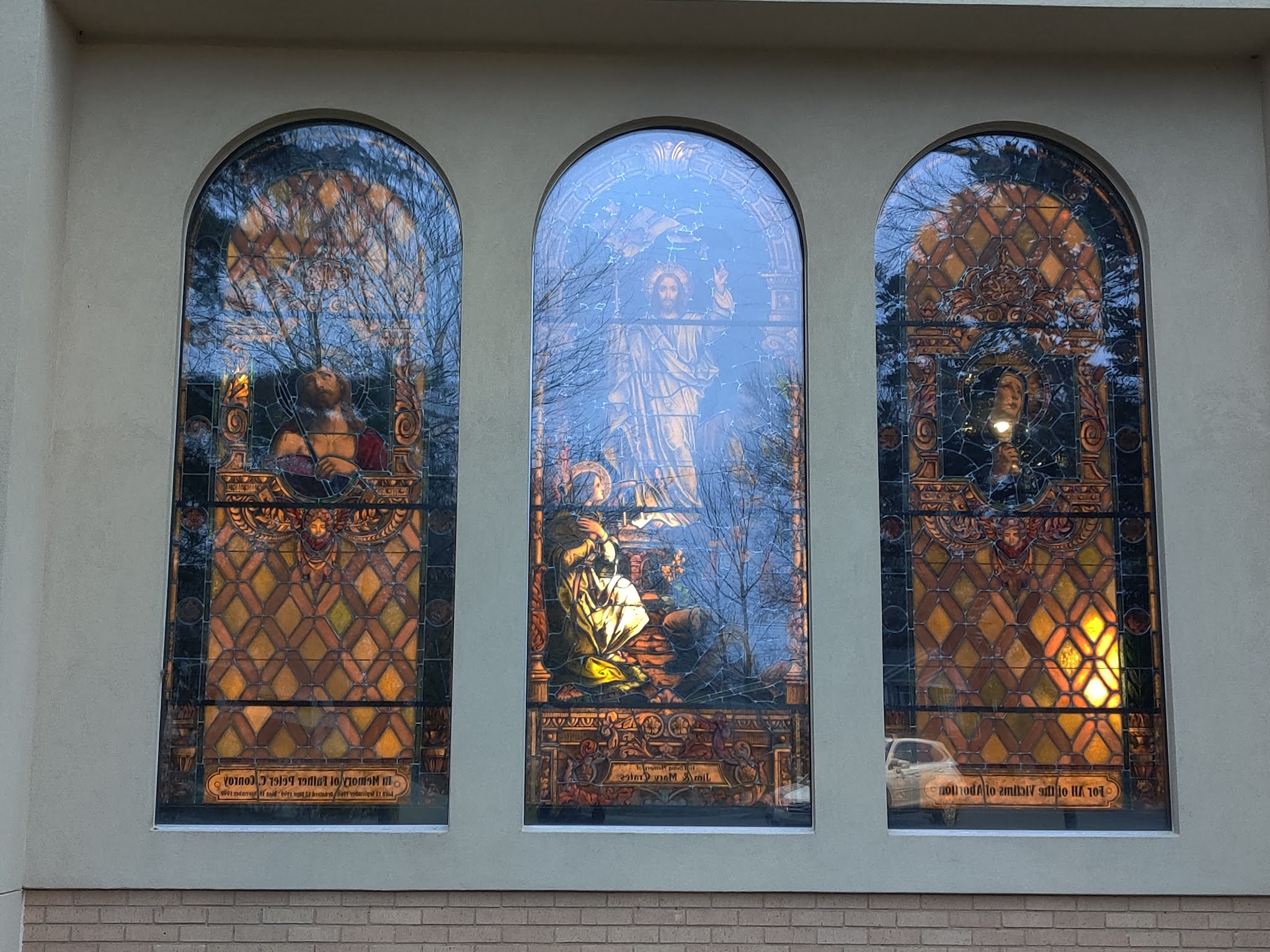
After a period of time passed during which I watched throats be blessed (simply fascinating!), I departed and took pictures of the stained-glass windows from outside of the church. The reflection of the trees made for an interesting glimpse of these beautiful windows.

I saw a small figurine as I exited the church, its picture is included below.


It's baby Jesus


Then I went home.

An engaging and unique experience at a church that is one of the most striking that I have experienced while on this journey. Thanks to Saint Ann Church for the great visit.


Wednesday, January 20, 2021

40 :: Belmont Foursquare Church

I worshipped at Belmont Foursquare Church on Wednesday evening. This took place in Belmont, NC, about twenty minutes outside of Charlotte. As I have mentioned in a previous post, Wednesday night church in the Southeast is still a common phenomenon, although it is becoming less so with the passage of time. Churches that meet on Wednesday night also usually have a Sunday morning and Sunday evening service, as well. 

This congregation was perhaps the warmest and friendliest that I have encountered on this spiritual pivot. There were about twenty people at the service, and I think about fifteen of them greeted me personally. In each case, it was with a warm smile and some friendly conversation. They seemed curious about who I was and eager to make me feel at home. 

First, you may be wondering - what is a Foursquare Church? It is a branch of Pentecostalism that started in Los Angeles in 1923. In part, the emphasis on four squares stems from the four faces of a Seraphim. These are the mystical beings with a face of a man, a bull, an eagle and a bear. They figure prominently in both the Book of Ezekiel and the Book of Revelations.

I sense there is some fascinating theology at the root of this emphasis on the faces of a Seraphim, but I have not gone deep into it.

More recently, the emphasis on this number in Foursquare theology is related to four dimensions of our Messiah - Jesus as Savior, Jesus as Baptizer with the Holy Spirit, Jesus as Healer and Jesus as Soon-coming King. Read more about the Foursquare Church at this [link]. The Foursquare Church movement has an emblem that represents each of these four dimensions of thλόγος

Here is that emblem:

When I got inside the church, I saw that every other pew was taped off for Covid-related reasons. I took my seat up near the front and settled into the comfortable environment. It seemed like I stood up every few minutes as someone else came by and said hello to me. Simply great people.

Here's the front of the church:

Eventually, a man named George (he had introduced himself to me) walked slowly up the front of the church with his guitar. He was accompanied by others from the congregation. They helped him walk up the two steps at the front, as George is very aged and had some mobility issues. When George got up there, he strummed out two songs and sang, as did those who had gone up to stand with him. The rest of us followed and sang with enthusiasm. In between the two songs, George leaned forward to the microphone and said that he was glad that he had the security of salvation in his life. 

After the music finished, it was announced that the Pastor was away on vacation and that a member of the congregation would be giving the Bible study this evening. That is when a woman named Gail came to the front of the church and opened her Bible. I had met her and her husband Darryl a few minutes prior.

Gail's Bible study had an interesting approach. Gail used words within words. 

She started by saying that she had a word that God put on her heart each year. The word God had given her for 2020 was HOPE. She explained that God also revealed that there is an acronym underneath each word given to her. For HOPE, the next level of deconstruction from God was Hold Onto Promises Everyday and He Offers Peace Everyday.

As the Bible study unfolded, I noted that this was a very interactive church in terms of style - as Gail would speak from the pulpit, the congregation would say something in affirmation back to her points. 

"Amen!"

"Praise the Lord!"

"Mmhhmm."

"That's right!"

I applauded multiple times as Gail made points from the pulpit, as I often do at interactive churches. At Belmont Foursquare, everyone quickly followed my applause. That doesn't happen everywhere, and I loved that aspect of being with these people.

Gail said that God had given her word for 2021 and it was LET. The next level of deconstruction was Leave Everything To.

Gail said that God had told her that LET could also be LETS - Leave Everything To Savior or Leave Everything To Satan. 

More applause.

Then Gail proceeded to expand on all of the times that the word LET is at the front of a Bible verse. 

It's frequent. 

Gail also organized a series of questions around this word, including the idea of pursuing redemption and salvation in Jesus while holding onto conditions... what she called "let me first sentences."

A well-known example of a "let me first" is from Luke 9:57-62.

As they were walking along the road, a man said to him, “I will follow you wherever you go.” Jesus replied, “Foxes have dens and birds have nests, but the Son of Man has no place to lay his head.”  

He said to another man, “Follow me.” But he replied, “Lord, first let me go and bury my father.” Jesus said to him, “Let the dead bury their own dead, but you go and proclaim the kingdom of God.” 

Still another said, “I will follow you, Lord; but first let me go back and say goodbye to my family.” Jesus replied, “No one who puts a hand to the plow and looks back is fit for service in the kingdom of God.”


Once Gail had deconstructed the word LET, she moved on to provide spiritual principles that align to each letter of the alphabet. Twenty-six unique ideas that were simple, accessible and meaningful.

I wondered right away what the X word would be. It is seen below.


All of this was executed in a highly structured and accessible way. Candidly, I was impressed. 

When she was done, Gail was clearly ready to be finished. She explained the meaning of the letter Z and then smiled, saying, "Thank you, you're dismissed." 

I started applauding. Everyone else joined in, clapping heartily. She beamed. I could tell this was a big deal for her. Darrell also looked happy. 

As we milled around after the Bible Study, many of the congregants came up to me and thanked me for coming, using my name. 

That is the way church is supposed to be, no?

As I left this brief and impactful Bible study, I thought about the significance of the day. 

This was Inauguration Day in the United States. 

It was a peaceful transition of power in a long series of such transfers, but this one can feel somewhat different. Our country is divided. Perhaps in a way that it has not been since the Civil War. And that is a deeply troubling trend.

With that said, this congregation reminded me that there is still an inherent decency at the core of our nation. 

If we only view the United States through the images that come to us through on our screens, we could quickly think that our entire country is a divided mess. Race, class, ethnicity, religiosity, worldview, sexual orientation, political perspective and region are some of the ways that we are said to be divided in an irreconcilable way. 

I contend that if we take time away from our screens and make direct human connections, we will almost always find a different reality. People are generally very kind and warm. People help each other. People greet strangers and make them feel at home. 

That warmth is not always evident in many places around the world. I have had the good fortune to travel widely in this world, having been to thirty-six countries. I can tell you that the people in the United States are qualitatively different than much of the rest of the world. Put simply, we're a very good people, overall.

Belmont Foursquare Church reminded me of that goodness.

My sincere thanks to Gail and everyone else at Belmont Foursquare Church. It was an awesome experience.

Saturday, January 16, 2021

39 :: Hope of Israel Congregation


On Saturday I worshipped at Hope of Israel Congregation, a Messianic community here in Charlotte. I mention that it was on a Saturday because this was an experience in a synagogue that was filled with believers of Yeshua Messiah (such language was in use throughout my visit, more on that throughout this post). I count it as one of the highlights in visiting one hundred churches thus far, it was simply inspiring and truly fascinating. 

The congregation has a higher sensitivity to security than most, so I don't have any pictures or videos to share of the experience. But what I saw was really, really interesting and I am glad to recount it in words only.

First, what are Messianic Jews? 

This is the term that is used for followers of Yeshua, which is the true name of The One that we follow, and who accept Him as Ha'Mashiach (the Hebrew word for "Messiah" or "Christ"). Even giving a description of this part of the Body of Christ requires me to use terminology that I am only slightly accustomed to. Many of the words are not normative for me based on my upbringing. 

The question does arise - Are these Jewish Christians? 

While that may seem to be a useful description to get to the heart of the matter, it is a wrong way of approaching the question of who these believers are. These are not Jews who are joining the mass of Gentiles who follow Jesus. 

The answer to this question is truly a "no." 

Instead, these are Jews living the extension of their very Jewish faith in which they understand the Redeemer of Israel and the World to have come in the person of Yeshua, the person we Gentiles call "Jesus."

If my description isn't clear, click here [linkto read their self-description, it's really concise.

To understand why this was so fascinating to me requires some description of the life I've led. 

My life has been very much bound up in the Jewish community. I grew up in Westport, Connecticut. It was (and is) a town with a very large Jewish population, perhaps as high as one third of the town. I have often made quick friends with Jewish people in my peer groups. I worked in a kosher bakery while I was in graduate school, a place that served challah to the most observant Jews in New Haven, Connecticut back in the early 1990s. I have also traveled to Israel, which was a transformative experience for me. My travel companion to Israel  was my fraternity brother and roommate, himself a Jew. In short, my entire life has been colored and shaped by my proximity to Jewish people. 

To have had the experience of worshipping our common Messiah with Jewish people was simply an incredible thing for me. 

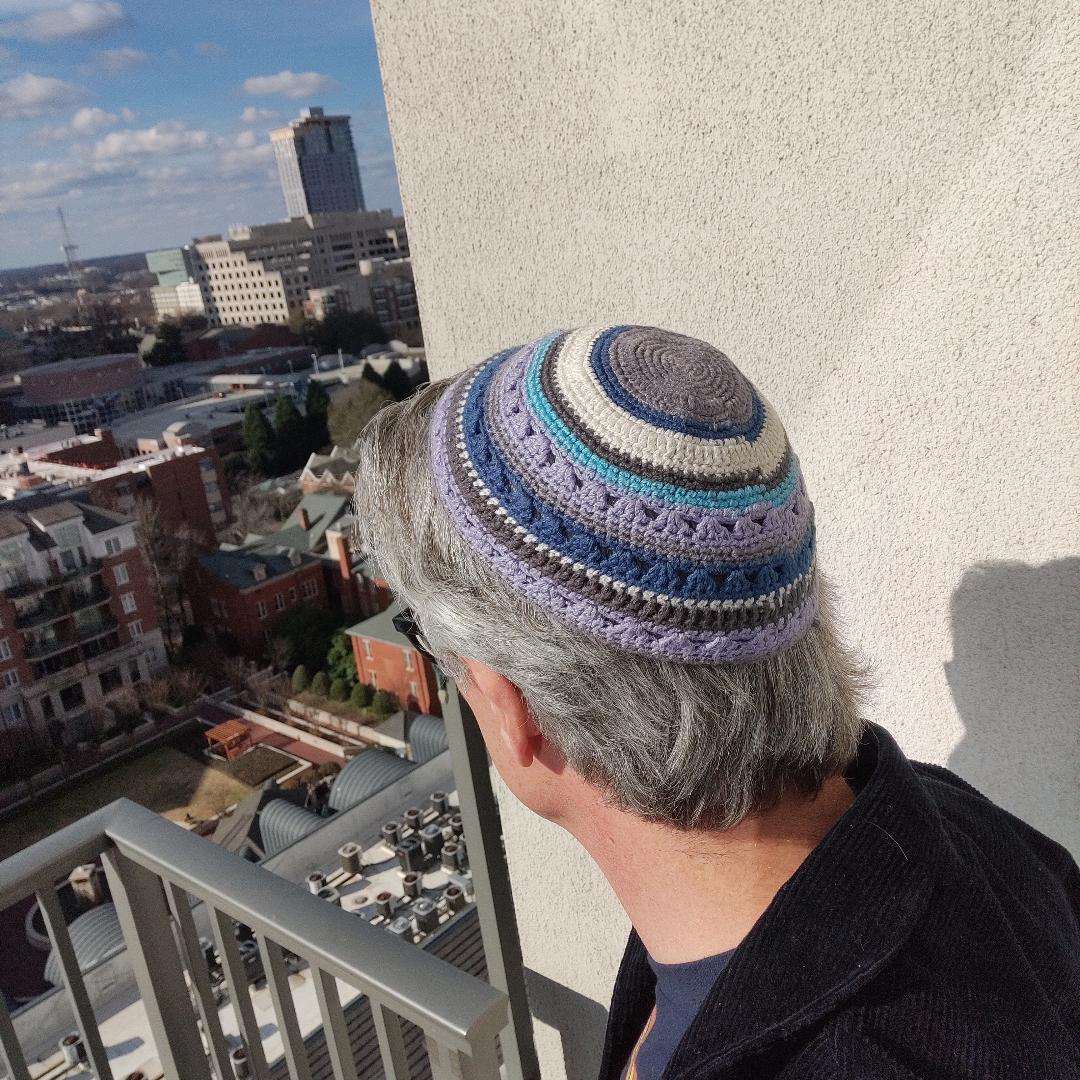
I left my apartment early Saturday morning wearing a kippa that I had purchased in Jerusalem in 2017. 

When I arrived at Hope of Israel, I saw a really attractive synagogue. It is a relatively new and nicely designed building. Here is a video [link] about the building's expansion. Below is a picture from the web:

When I entered, I wandered around for a bit, taking in the internal structure. My goal was to attend the equivalent of Sunday School (again, terminology breaks down quickly in this setting), so I arrived early. I asked a woman I met where the classes were meeting. She pointed me to a Men's Class down the hall. I later came to find out this was Rabbi Nadler's wife, Miriam. 

When I joined the Men's Class, I was immediately struck by the diversity. There was a guy from Israel, a man from Latin America, another guy who led the class who seemed definitively Southern, and multiple other men of different backgrounds were gathered in person. There was also one man joining via video. Most, but not all, were wearing kippot. The rapport between the men was great, I could tell that they had built a solid community.

The lesson that was taught related to the tumult of the world around us. There was no need to level set on what was being talked about - the world is definitely in a very unique state of division and instability. We are all feeling it. This is especially acute as we move past one of the most divisive elections in the history of our Republic. Additionally, there has been political violence in the country for nearly a year now. And we are all living very differently due to the pandemic event that we find ourselves living through.

In short, this is a time when it would feel easy to be anxious, distracted, depressed and even under threat.

The message that was given during that class was that there are four directions we need to stay focused on as believers and as men. 

  • The first direction is upward, keeping our lives of prayer healthy and vital. 
  • The second direction is facing toward the Earth, where we can provide leadership and strength to those who depend on us. Our families are here. 
  • The third and fourth directions are to the right and left sides, where we engage with the world around us and all those who occupy those lateral relationships.
 This is a simple and clear way to get our thinking organized in how we interact with the world around us as it goes through unprecedented convulsions of change.

One of the men mentioned that he has been a lifelong hunter. He mentioned how in hunting, it is essential not to get distracted by the things in the woods around you. The chirping of birds, the darting of a squirrel and huge gusts of wind are the things that can distract a hunter while tracking his prey. He made the point that we also need to avoid distractions of social media, political division and confused thinking within our own minds. 

The point - life is like a hunt that requires men to focus and not get distracted as they pursue their prey.

Yes, yes and yes.

After the Men's Class, I went into the worship service. This was where things got extremely interesting! If everything I had seen thus far had been uniquely contextualized as a Hebrew setting filled with belief in Yeshua Messiah, the worship service itself took it up several levels.

The music started up and there were dancers doing traditional dances in the corner of the sanctuary. There was a bimah in the front, as is the case with every synagogue in the world. In the bimah was a Torah, wrapped in an embroidered cloth as you would also see at any synagogue around the world. Some of the praise songs were in English and Hebrew, with words from both languages and alphabets on the screens overhead. Many of the men were wearing a tallis. Most men in the sanctuary were wearing a kippa. People greeted each other with "Shabbat shalom," a greeting reserved for the Saturday Sabbath.

Of note, God was written as G-d very often. I may know a bit about this, so let me elaborate. The name of God that was given to Moses on Mount Sinai was יהוה‎ ‎. These four letters, read from right to left, are known as the tetragrammaton. Yod - hey - vav - hey. They roughly translate to YHWH or JHVH. This is where the words Yahweh and Jehovah come from. 

While we Christians use the words God or The Lord in our lexicon, this is another example of the cultural drift that occurred as Messianic Judaism spilled over into our world. 

God's true name is יהוה‎.

In Judaism, יהוה‎ is something treated with the highest reverence. Instead of developing a word from the letters יהוה, Jews might instead say Ha'Shem, which means The Name. Or they may say Adonai, which we write as The LORD (all caps) in our Old Testament translations. 

The name יהוה is considered so holy as to merit special attention and is not to be written or spoken in a casual manner. I believe Messianic Jews write G-d in acknowledgment of the holiness of the tetragrammaton.

If you know me, you can imagine how fascinating this was for me. And to see people in tallitot and kippot lifting up the name of Yeshua was an immense privilege and pleasure. Put simply, my mind was blown.

The sermon was about marriage and focused on 1 Samuel 18.

Here's the YouTube of the sermon, please watch it - it'll be the best 45 minutes of your day, I promise. Rabbi Sam Nadler is a dynamic and entertaining teacher.

As the service wrapped up, one of the men from the Men's Class came up to me and struck up a conversation. This was David and his wife Teresa. They are both Gentiles and came to Messianic faith through a class they took in Haifa, Israel years ago. David was wearing the Star of David on his necklace. He was good enough to explain that an important book for Gentiles to read is The Book of Ruth. David explained that this part of our story as Gentiles in the Old Testament.

I will definitely read Ruth this year, as I am reading the entire Bible with Beth. I'll have new eyes during that book because of this conversation.

David also pointed out that the faith we follow is a Jewish faith. Because of this, he said it is useful to think of ourselves as members of what he called The Commonwealth of Israel.

This made a great deal of sense to me.

Teresa told me that the ancient olive trees on the Mount of Olives in Israel can take grafts from new trees and the grafted branches will grow. David's eyes lit up and he leaned forward and said to me, "That is also about us."

I smiled and said I understood. And I did. Gentiles are grafted in the Hebraic tree of Messianic faith in Yeshua.

My time at Hope of Israel Congregation helped me see something I am becoming more aware of in recent years. We are not Christians who are being joined by Jewish believers who are worshipping our Jesus. Instead, we are Gentiles who are participants in a faith that is at its very core a Jewish faith. We are following Yeshua Ha'Mashiach who came first for the Jewish nation and then for the rest of the world. 

All of that is how I, an American of mostly British ancestry, ended up in such a fascinating setting on Saturday.

The congregation also gave me a large amount of reading material. I will definitely read all of this, my imagination has truly been ignited. Note that the dates used are in both the Western and Hebrew calendars.


To have had this experience was very special to me and I thank Hope of Israel for their warm and accommodating company on Shabbat. 


Saturday, January 9, 2021

38 :: Saint Vincent de Paul Catholic Church

Today I attended Mass at Saint Vincent de Paul Catholic Church in South Charlotte. I have now attended Mass often enough that it is less unfamiliar to me. I still can't make out everything that is being repeated by the gathered faithful, nor do I know what to do in terms of standing and sitting at the right time. But it is becoming slightly more familiar.

There really is variety in the way that Catholic churches perform Mass. For example, this church had no music. That was a first for the Masses I have attended.

When I arrived, I spent some time checking out the property, both inside and out. Here's a bit of that (of note is that Mother Teresa is honored here):


As you can see, a beautiful place. 

Mother Teresa became a Saint in 2016, through the process that Catholics call beatification. I don't know much about it, but I believe there must be some evidence of the miraculous in the life of the person being evaluated for Sainthood. What she did that fulfilled that is anyone's guess. But when I lived in India, I remember how she was revered by people of all faiths. Simply an amazing person and a noteworthy life.

The homily was the memorable part of the Mass. It was about the Baptism of Yeshua.

The baptism is recorded in all four Gospels. It is performed by John the Baptist, Yeshua's cousin. Once the act is done, there is reference to the Spirit of God descending like a white bird. Heady stuff, for sure.

Here are the links - Matthew 3:13-16, Mark 1:9-10, Luke 3:21, John 1:29-34.

An interesting question was explored during the homily. As the only person to have lived a human life without the dark weight of sin, why did Yeshua require baptism? The Priest offered that it wasn't to experience forgiveness, but rather to sanctify the act of Baptism. He put Himself at the front of the long and ongoing individuals who partook of this new sacrament, Baptism. That line includes billions of people who followed Yeshua in that act. May it go on into the future, too. 

It's like the Cross and the Empty Grave, if you think about it. Those acts were opening up eternal life forever. Only He could do that. Once done, we can also participate in that sacred practice, as well. Rising to New Life.

So, I left this Mass with a new understanding. For that I am grateful!

I went to Freedom House after Mass and experienced a very different kind of worship. I continue to be struck by the myriad of ways that people seek His face.

In closing, I'll share a video that I find to be very moving. It is the song Surrounded by Upper Room. It says so much, and I hope you watch the whole thing.

I have become very accustomed to this kind of music and form of worship. With that said, I love seeing the variety that I am experiencing in all of these churches. I also love new insights and ideas that broaden my understanding. And the homily at Saint Vincent de Paul definitely provided me some of that. I remain grateful for such chances and thank this Catholic body for hosting me today.

Amen and... amen.


Sunday, January 3, 2021

37 :: Ocean Church, Estero


Today I worshipped at Ocean Church in Estero, Florida. This was another streamed service this week, as I have Covid-19! As such, I must pull back from the world for this Sunday.

Covid-19 sickness has been uncomfortable, but it is not the sickest I have been.

I chose to visit this church because it is near where my mother lives and I have been there before. Ocean Church has three locations in Florida. This was a good visit to the Estero campus.

The service started in a fashion that I have become accustomed to for contemporary churches - purple accent lights and a band. This band was solid.


After the band, Phil McMillan came out and led the church in prayer. 

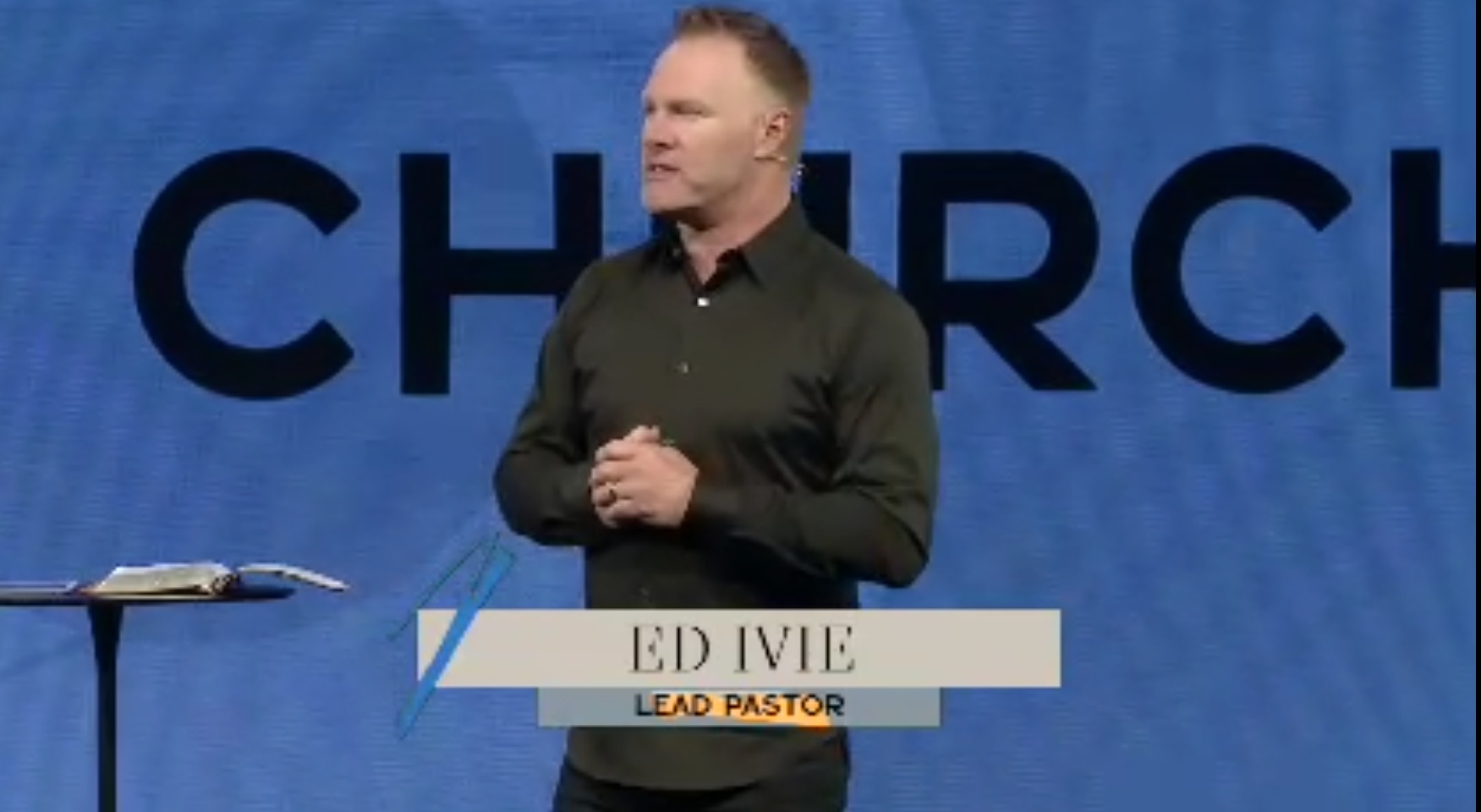
The main event was when Pastor Ed Ivie came out to give his message. Since this is my second time seeing Ed, the first time having been in person, I had some expectation in my mind about what I was going to get. This is a capable senior pastor and this sermon reflects some mellowing and texture that I didn't see in 2018. I think 2020 has had a huge impact on all of us, and this includes Pastor Ed.


This was the first in a series named Apocalypse Church. Based on the name of the message series, you can imagine that I was engaged and ready to hear more.

Pastor Ed and his wife Christy had just finished a sabbatical in the second half of 2020, part of it in the Upper Midwest. His reflections from that time were profound. Much of what he shared during the message were observations gained from the very unusual year behind us, as well as that sabbatical within it.

The main idea that Pastor Ed put forth was that this world is not our home, that Christians are truly and primarily citizens of Heaven. He offered up that we can expect to feel some level of strangeness at this idea, but it is our primary truth - we are not of this place. This is not our home.

In addition to this point, he had us reflect back on 2020 overall, as well as where we all were one year ago, before the pandemic. He asked all of us to consider how the year had changed us. How it had impacted our relationships. How it made us look at life and death. How it interrupted the entire world out of a level of illusion and complacency into sharp focus.

These were beautiful sentiments and rang true. And part of me was expecting something different based on the series name of Apocalypse Church. The four beasts chanting through eternity at the base of God's throne. The Council of Elders casting down their crowns. The eagle soaring above the silent throng as the next Seal is opened.

That sort of Apocalyptical stuff?

No.

ἀποκάλυψις is a Greek word from which we derive the word apocalypse. It's meaning is "the lifting of the veil." That process whereby our vision is not longer clouded and we can see reality in its fullness. The old is shed and the new is embraced.

That is, in point of fact, what the word apocalypse means. 

Last year was arguably the best year I have had in a long time. Perhaps ever. I fell in love and met the woman I am going to marry this year. That's a huge deal!  202 was awesome, in reality.

This during the same time that something of great darkness was rolled out across the world and onto an unsuspecting humanity. 

That is also the way apocalypse works - lifting of the veil so we can be witnesses to God's grandeur, even as suffering and injustice may proliferate around us. Then - everything moves to a final resolution.

I had a good time at Ocean Church. I will be visiting their Naples campus when I am down in Florida in April. Blessings upon this community.


Sunday, December 27, 2020

36 :: Holy Trinity Roman Catholic Church

This morning I streamed a Mass at Holy Trinity Roman Catholic Church in Dunkirk, New York. Dunkirk is outside of Buffalo. My occasion to attend the service was driven by two variables. First, my youngest son Jonah has Covid-19 (he is fine) and until I get my test results, I thought it irresponsible to attend church in person. Secondly, my close friend Dave has moved from Charlotte back to his native home around Buffalo in the last year. He recently heard a homily during Mass that he felt would have been of interest to me. He sent a link to the church that I have held onto until this morning.

I attended the 8:30 Mass this morning, streaming via the WDOE channel on TuneIn, a radio app. Beth also listened in, so we "went to church together" again, albeit virtually.

Dunkirk is far away. This was my first time doing one of my church visits online. It was my sixth Catholic Mass. With all variables taken into account, it made for a unique experience. The Mass was forty-five minutes in length, followed by fifteen minutes of Christmas caroling inside the church. All told, it was a very unusual way to end this most unusual year.

The homily (sermon/message) focused on one of the great stories of the Bible, which I believe most people might not readily know. It takes place in the second chapter of Luke and recounts when Joseph and Mary brought the infant Yeshua to The Temple in Jerusalem to be blessed. While in The Temple, they encountered Simeon, a holy man who spent all of his time in The Temple. Of significance is that Simeon had been told earlier in his life that he would not die before he saw the arrival of the Savior. 

The moment that Joseph and Mary walked into The Temple, Simeon focused on the baby Yeshua. He held him up and sang what is known as The Song of Simeon (Luke 2:29-32):

“Sovereign Lord, as You have promised,
you may now dismiss Your servant in peace.
30 For my eyes have seen Your salvation,
31 which You have prepared in the sight of all nations:
32 a light for revelation to the Gentiles,
and the glory of Your people Israel.”

Essentially, Simeon was saying, "I've seen God's arrival on Earth, as promised. Now, I can die."

This Song of Simeon is also known as the Nunc Dimittis. Bach and other composers have written symphonic pieces of music related to these verses of the Gospel of Luke. Put simply, this may be one of the most relevant parts of the New Testament that most people have not heard of.

The Song of Simeon made an impact on me years ago. I remember considering how Simeon's life was spent in quiet anticipation of the arrival of the Hope of Israel and subsequently, humanity's hope. Despite the fact that Simeon was located in the most holy place in all of Judaism, he was acutely aware that something was missing and something was pending. 

Think of it - Simeon was in The Temple in Jerusalem. The holiest place on Earth in Hebraic cosmology. The Temple was built around the Creation Stone, the place where the world as we know it came into existence. This was precisely the place where the Holy of Holies was located, which was where The Ark of the Covenant was stored. Finally, it was the place where the Jews had settled after their forty years in the desert while fleeing captivity in Egypt. 

The Temple in Jerusalem

A very holy place in every way! 

Despite being in this place of spiritual splendor and profound theological significance, Simeon had decided to wait for what wasn't yet to be found in the world. He was waiting for the arrival of a Redeemer of his people and of the world. He was waiting for this Savior despite the presence of crowds that were coming and going in The Temple around the clock. Simeon refused to focus solely on the Covenant that existed in Israel at that time. He waited patiently for the time that he could play a role in honoring the arrival of what the Hebrews called Ha'Mashiach... The Messiah.

When the little baby came into The Temple, Simeon knew right away. He gravitated toward Yeshua in a moment. He held the newborn Yeshua up in his hands. And then Simeon made a spiritual declaration in the form of the Song. 

I've often wondered if Simeon was surprised to see that salvation was coming into The Temple in the form of a little baby. Perhaps he was expecting a Warrior King followed by an army of soldiers. Perhaps he was expecting a white haired Priest from the Levite clan, marching into The Temple with a long path of scribes and philosophers in tow. 

Who knows what Simeon thought was coming to redeem the Universe?

What we do know is that Simeon saw a little baby who was carried by a young and humble couple of no significant social status - yet he recognized right away that his Redeemer lived! How did Simeon know? What tipped him off that this baby was the fulfillment of his life's waiting? How did he feel as the couple left him, knowing that he could now die in peace? 

On all of these questions, we can only guess.

Simeon is never mentioned again in The Bible.

The Priest continued with his homily. In the same chapter, we meet Anna. She was a prophetess, an elderly window and also a devout Jew who spent her days in The Temple. Anna and Simeon very likely knew each other, even though we have no independent validation of that. And she also took note of the baby Yeshua. Luke 2:36-38 says:

There was also a prophet, Anna, the daughter of Penuel, of the tribe of Asher. She was very old; she had lived with her husband seven years after her marriage, and then was a widow until she was eighty-four. She never left the temple but worshiped night and day, fasting and praying. Coming up to them at that very moment, she gave thanks to God and spoke about the child to all who were looking forward to the redemption of Jerusalem.


As I read this, I considered that Anna occupies a very unique place in Christian history, as she would qualify as the second evangelist of the Good News, after John the Baptist. Her first impulse was to talk to those around her about what she had seen and experienced. That Redemption was here!

Of note is that I was hearing about Anna the prophetess in a Catholic Mass, which explicitly forbids women from participating in their clergy. It could be argued that if God is fine with women being prophetesses, how could an Earthly institution take a stance that might be seen as diametrically opposed?

Of note, both Simeon and Anna are thought of in Orthodox theology as the last prophets of the Old Testament.

I loved that the homily explored this rich chapter of the Bible that I have not pondered in years.

Then, the reading from the Bible was from a book that is not in the canon that I am accustomed to. The reading was from Ben Sira 29:11. This book in the Catholic Bible is also called Book of Sirach, part of the Apocrypha. 

The verse goes as follows:

Dispose of your treasure according to the commandments of the Most High,
and that will profit you more than the gold.

An invitation to using material assets for the Kingdom of the Most High, instead of for our own aggrandizement. Yes!

Wisdom from a book of the Bible that I have never read. For that matter, a book that isn't even in my Bible. What else is contained in The Apocrypha that is worth pondering is only a guess. I read parts of it more than twenty years ago and never returned for more. 

In 2021, Beth and I are going to read the entire Bible together, minus The Apocrypha. If I know the two of us, we will eventually end up reading The Apocrypha. It just won't be next year.

As the Mass completed, I texted Dave and told him that we had tuned into the Mass at his church up in Dunkirk. He said he had been there for the same Mass with his Mother. Small connections across long distances via the internet while experiencing a form of worship that goes back more than two millennia. These really are remarkable times.

Thanks to Holy Trinity for virtually hosting us, it was interesting and unique to attend church this way.